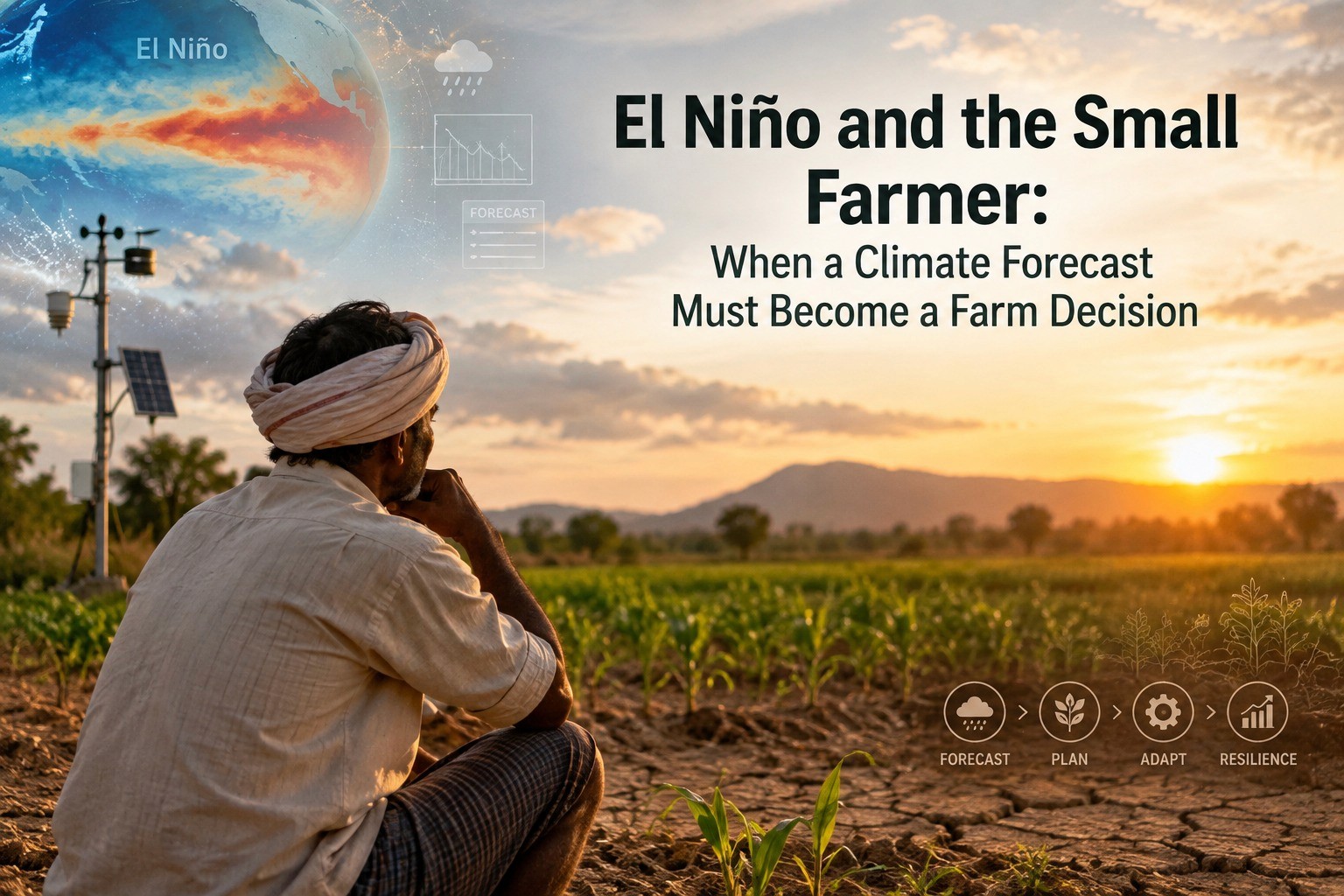
For a small farmer, climate change is not a concept discussed only in reports or conferences.
It can mean waiting for the rain to arrive before sowing. It can mean watching a crop struggle because the rain stopped at the wrong time. It can mean a borewell running dry, spending more money on irrigation, or wondering whether it is worth sowing another crop at all.
This is where a climate phenomenon like **El Niño** becomes important.
El Niño may begin thousands of kilometres away in the Pacific Ocean, but its effects can be felt much closer to home—including in India's agricultural fields.
What is El Niño?
El Niño is a natural climate phenomenon in which sea-surface temperatures become unusually warm in parts of the central and eastern tropical Pacific Ocean.
This warming can influence atmospheric circulation around the world and, in some years, affect the Indian Summer Monsoon.
But there is an important point to remember:
El Niño does not automatically mean drought in India.
India's monsoon is influenced by several factors, including the **Indian Ocean Dipole (IOD), Madden–Julian Oscillation (MJO), atmospheric circulation and changes in rainfall patterns within the monsoon season**.
So, the real question for farmers is not simply:
“Will there be less rain?”
It is also:
“When will the rain come, how much will fall, and will it come when the crop needs it most?”
Why Does El Niño Matter to Small Farmers?
Indian agriculture remains closely connected to the monsoon.
According to the India Meteorological Department's 2024 monsoon assessment, around 54% of India's net cultivated area is rain fed.
For farmers without reliable irrigation, the monsoon influences almost every stage of farming—from preparing the field and sowing the seed to crop growth, groundwater recharge and the availability of water for the next season.
This makes small and marginal farmers particularly vulnerable to irregular rainfall.
A delayed or poorly distributed monsoon can trigger a chain reaction:
Irregular rainfall → less soil moisture → delayed sowing → poor crop establishment → lower yields → income loss → greater financial stress
What starts as a weather problem can quickly become a livelihood problem.
When Rainfall Timing Matters More Than the Total
Farmers do not experience rainfall as a yearly average.
They experience it day by day, week by week and season by season.
For example, receiving enough rainfall over a season does not necessarily mean a crop will perform well. If there is no rain during germination or a critical growth stage, the crop can still suffer.
A few weeks of delayed rainfall can shorten the growing season and force farmers to make difficult choices.
Should they wait?
Should they sow a different crop?
Should they use expensive irrigation?
Should they resow?
Or should they leave part of the land uncultivated?
These are not just agricultural decisions. They are financial decisions for a farming household.
Recent rainfall patterns have highlighted this vulnerability. *Down To Earth* reported that India's southwest monsoon began June 2026 with a **40% rainfall deficit**, while 76% of districts had recorded deficient, largely deficient or no rainfall by June 29.
The larger lesson is important:
A national rainfall average does not tell the whole story.
A farmer does not experience India's average rainfall.
They experience the rain—or the lack of it—in their own field, village and watershed.
Who Is Most Vulnerable?
Climate risk is not the same for every farmer.
The Government of India and ICAR identified **315 districts potentially affected by weak monsoon conditions in 2026**, with **111 districts classified as high priority because irrigation coverage was below 25%**. Karnataka was among the states with identified vulnerable districts.
This brings us to an important idea in climate resilience:
Climate risk depends not only on the hazard, but also on exposure, sensitivity and the ability to adapt.
Consider two farmers receiving the same amount of rainfall.
One may have a farm pond, diversified crops, access to weather information, savings and irrigation.
The other may depend entirely on rainfall and a single crop.
The weather event is the same.
The level of risk is not.
Five Ways Climate Variability Can Affect Small Farmers
1. Crop and Yield Losses
Water is critical during different stages of crop growth.
When rainfall does not arrive when the crop needs it, germination, plant growth and final yields can be affected.
Rain fed cereals, pulses and oilseeds can be particularly vulnerable to prolonged dry periods.
For a small farmer, even a modest reduction in yield can have a significant effect on household income.
2. Water Security Becomes Farm Security
Less rainfall does not only affect the crop growing in the field.
It can also affect ponds, tanks, streams and groundwater recharge.
When surface water becomes scarce, farmers may become more dependent on borewells and irrigation. This can increase cultivation costs and put additional pressure on already stressed groundwater resources.
That is why:
Water security is agricultural security.
Rainwater harvesting, farm ponds, soil-moisture conservation and efficient irrigation are therefore not simply environmental measures—they are tools for protecting farm livelihoods.
3. Rising Cost of Cultivation
A climate shock can quickly become a financial shock.
When crops are affected, farmers may have to spend more on:
* Irrigation
* Seeds
* Resowing
* Fertilizers
* Pest management
* Labour
* Additional farm operations
At the same time, the final harvest may be smaller.
This creates a difficult cycle:
Higher costs + lower production = greater financial stress
For farmers already operating with limited savings, one difficult season can make recovery much harder.
4. Livestock and Other Livelihoods Are Also Affected
A farm is not always dependent on crops alone.
Many small farming households also depend on livestock, poultry, and horticulture, dairy or other activities for income.
When rainfall is poor, fodder and water availability can also decline, affecting livestock productivity and household earnings.
This is why a climate-resilient farm should be viewed as a diversified livelihood system, rather than simply a crop-production unit.
5. The Impact Can Reach the Entire Rural Economy
The effects of climate variability do not stop at the farm gate.
When agricultural production falls, farm incomes can decline.
Lower income can affect spending on education, healthcare, household needs and future farm investments.
At a larger scale, reduced production can also contribute to changes in food availability and prices.
In this way, a rainfall shock can travel through the rural economy:
Rainfall shock → crop stress → lower production → reduced farm income → increased economic pressure
From Climate Vulnerability to Climate Resilience
So, what can we do?
The answer is not simply to predict El Niño more accurately.
The bigger challenge is to ensure that climate information reaches farmers early enough to support real decisions.
India has been working towards this through District Agriculture Contingency Plans (DACPs), which provide location-specific strategies for dealing with weather-related risks.
For farmers, these strategies can translate into practical actions.
Climate-smart cropping
Choosing drought-tolerant, short-duration or locally suitable crop varieties based on expected rainfall and available water.
Water harvesting and moisture conservation
Farm ponds, check dams, rainwater harvesting, mulching and other soil-moisture conservation practices can help farmers make better use of available water.
Crop diversification
Growing a combination of cereals, pulses, oilseeds, horticultural crops or integrating livestock can reduce dependence on a single crop and income source.
Agro-meteorological advisories
Weather information becomes much more useful when it answers practical questions:
When should I sow?
Should I irrigate today?
Should I wait before applying fertilizer?
Should I choose a short-duration crop?
This is where climate science can become useful at the farm level.
Risk-transfer mechanisms
Crop insurance, access to institutional credit and social protection programmes can help farming households manage the financial impact of climate shocks.
Agroforestry and ecosystem-based approaches
Trees on farms can provide additional biomass and income while helping protect soil, support biodiversity and improve the resilience of agricultural landscapes.
The Real Shift: From Forecasting to Preparedness
One of the biggest lessons from climate variability is that a forecast is useful only when it leads to action.
Knowing that rainfall may be delayed is important.
But what matters even more is what happens next.
Can the farmer change the sowing date?
Can they select another crop?
Can they access a weather advisory?
Can available water be conserved?
Can they protect their livestock?
Can they access financial support if the crop fails?
This is the shift we need:
From climate prediction → to climate-informed decision-making.
Climate information should not remain inside weather bulletins, research papers or policy documents.
It needs to reach the field.
El Niño Is a Climate Signal, Not a Farmer's Fate
El Niño will continue to be an important climate signal for India.
But its impact is not predetermined.
The outcome depends on many factors—including rainfall distribution, local water availability, soil conditions, crop choices, irrigation access, ecosystem health, government support and the ability of farming communities to adapt.
The goal, therefore, should not simply be to protect farmers from the next El Niño.
The bigger goal is to build farming systems that can withstand uncertainty.
For India's small farmers, climate resilience needs to move from being a policy concept to becoming a practical reality—supported by science, local knowledge, water security, diversified livelihoods and timely agricultural advisories.
Because the future of farming will not depend only on whether the monsoon arrives.
It will depend on how prepared we are when the monsoon behaves differently from what we expected.
Key Takeaway
El Niño may be a global climate phenomenon, but its consequences can be deeply local.
For a small farmer, resilience means more than knowing what the weather might do. It means having the knowledge, water, resources and choices to respond when conditions change.
Climate resilience begins when climate information becomes a decision at the farm level.
And ultimately, building resilient agriculture is not only about protecting crops.
It is about protecting livelihoods, food security and the future of rural communities.
**— Vidya**
Next